Articles
Practical guides to U.S. withholding tax on payments to non-U.S. persons — treaty rates, W-8/W-9/8233 forms, and 1042-S compliance.
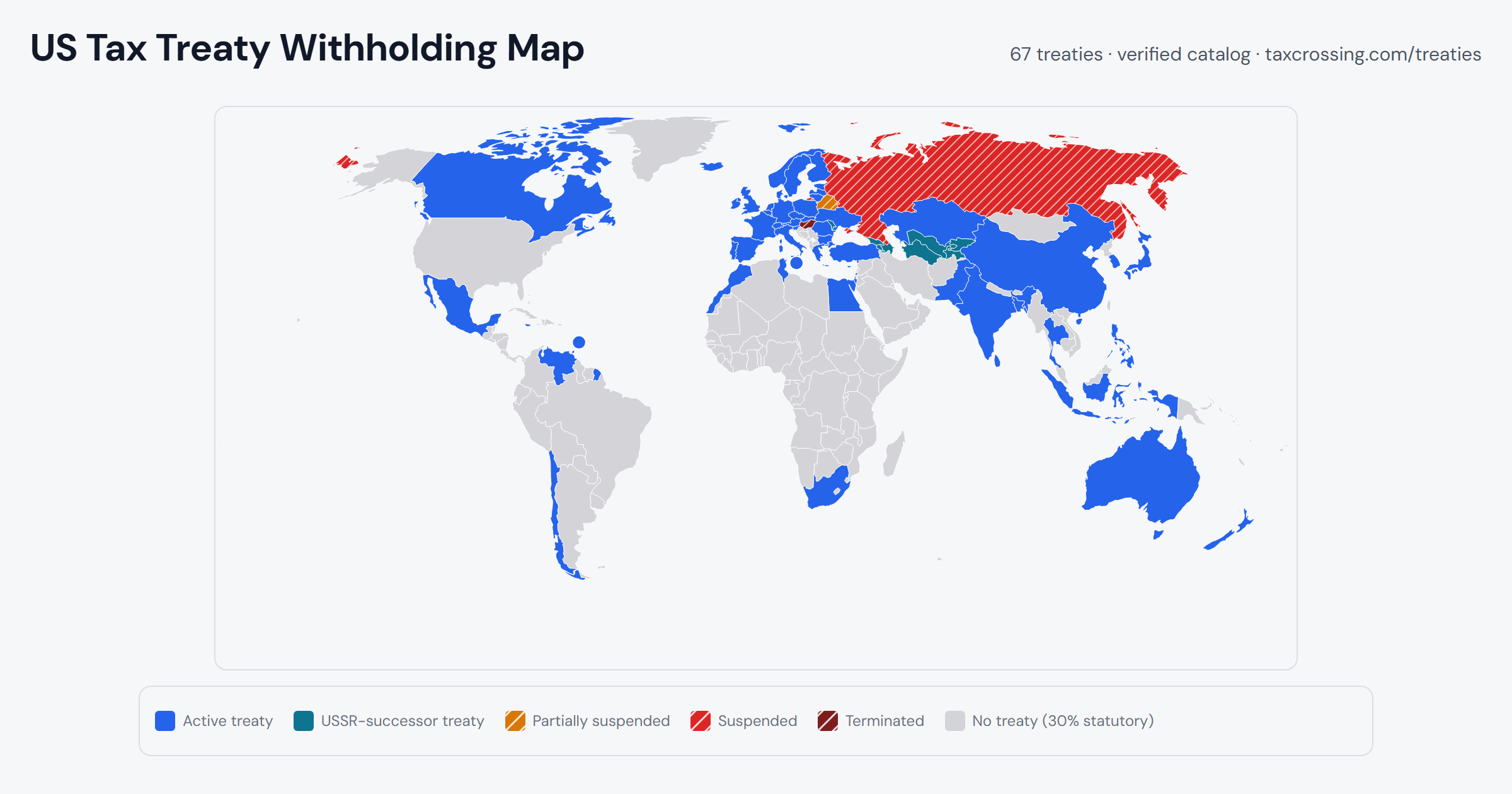 US Tax Treaty Withholding MapTreaty status and withholding rates across all 67 US treaty relationships, by income type.
🎯Withhold or Not?Seventeen real payment scenarios. Call each one: withhold 30%, apply the treaty rate, or pay gross.
💡WHT FactsOne verified withholding fact at a time: the traps, the myths, and the numbers that decide real payments.
US Tax Treaty Withholding MapTreaty status and withholding rates across all 67 US treaty relationships, by income type.
🎯Withhold or Not?Seventeen real payment scenarios. Call each one: withhold 30%, apply the treaty rate, or pay gross.
💡WHT FactsOne verified withholding fact at a time: the traps, the myths, and the numbers that decide real payments.
Paying Affiliates and Creators Abroad: Which Form to Collect, and When the 30% Applies
A commission for work done abroad is foreign-source: no withholding, no 1042-S, keep the W-8BEN. A usage-rights or whitelisting fee for a US audience is a royalty: 30% unless the W-8 claims a treaty rate. One payout run, payee by payee, including the commission that was really whitelisting.
Withholding Mechanics"Our CPA Said We Do Not Need W-8s": What a US Payor Actually Owes When It Pays People Abroad
The advice is right for work performed abroad and silent about usage rights, US-soil days, and who the withholding agent is when an agency pays on a client's behalf. What the file needs, payment by payment, and how to take the question back to your advisor.
Withholding MechanicsHow to Calculate Withholding on a Foreign Contractor Payment
The calculation is four questions, each of which changes the next: who is being paid, where the work was performed, what kind of payment it is, and which treaty article applies. This guide walks the sequence in the order a determination actually runs, shows the manual arithmetic at each step, and closes with what a tool does with the same inputs.
Withholding Mechanics1099 or 1042-S: Which Form Your Foreign Contractor Gets
US contractors get a 1099-NEC. Foreign contractors live in a different reporting regime: Form 1042-S, its companion Form 1042, and a 30% default the 1099 world never sees. The split, the zero-withholding trap, and when neither form is due.
Withholding MechanicsW-8BEN vs W-8BEN-E: The Difference, and Which Form Your Payee Files
The two forms split on one question: is the payee a person or an organization? This guide draws the line, walks the places it blurs (freelancers with business names, single-member LLCs), and shows what the entity form demands that the individual form does not.
Withholding MechanicsW-9 or W-8BEN: Which Form Does Your Contractor File?
The first certificate decides everything downstream, and the test is legal status, not geography. Green-card holders abroad are W-9 filers. F-1 students in year three usually are not. The rules, the surprises, and the foreign-owned US LLC.
Industry SpotlightsA Foreign Musical Comes to Broadway: Who Counts as an Entertainer?
A London production transfers to New York with its cast, director, choreographer, designers, and crew. The entertainer article taxes the performers on gross while the creative team analyzes as ordinary services, and the authorities draw the line more clearly than most payors expect.
GuidesUS Withholding on Payments to Foreign Persons: The Complete Guide
One guide to the whole system: the 30% statutory default, the source rules that run before any treaty, the income-type map, the W-8 documentation layer, treaty mechanics, and 1042-S reporting. Each section links to the full deep-dive article.
Industry SpotlightsHow a Foreign Stage Production Is Structured, and Where Each Structure Meets US Withholding
Direct engagement, a single production-company invoice, loan-outs for the leads, a license with services attached, and the arrangers around them all. This article narrates the five structures a US presenter meets and marks the withholding question each one creates, without advising which to choose.
Tax Treaty AnalysisConditional Director Fees: How the US-France Treaty Allocates Board Fees
Some US tax treaties condition a director-fee exemption on where the board work is performed, and France is one of them. The US-performed share of the fee is taxable at 30% while the foreign-performed share stays exempt. Here is how the allocation works, with a worked France example.
Tax Treaty AnalysisSix Ways US Tax Treaties Handle Director Fees
A reference guide to the six structures US income-tax treaties use for directors' fees, from flat 30% source taxation to conditional, pro-rata, meeting-location, and de-minimis relief, with the treaty wording that signals each and the countries in each group.
Withholding MechanicsFrequently Asked Questions: US Withholding Tax for Foreign Payments
Plain-language answers to the most common questions US payors ask about withholding tax on payments to foreign individuals and companies: treaty rates, W-8 forms, Form 1042/1042-S, sourcing, and more.
International ProductionsFilm and TV Royalties in US Tax Treaties: Two Different 'Exclusions'
Film and TV royalties are carved out of many US tax treaties, but in two very different ways that can change your withholding rate between 0%, 10%, and 30%. Here is how to tell them apart.
International ProductionsHow Film and TV Income Is Classified and Sourced for US Withholding
Before a treaty rate ever applies, a US payor must answer two questions about a film or TV payment: what kind of income is it, and where is it sourced? This guide walks through classification and sourcing for payments to foreign persons.
International ProductionsTwo Film Productions, Two Withholding Outcomes: Worked Examples
Follow two fictional film productions, 'Big Sur' and 'Echo Valley,' as a US payor walks each payment from classification to final withholding rate, and see why the same kind of payment can withhold at 0%, 10%, or 30%.
Withholding MechanicsWhat Is Income Code 24 on Form 1042-S?
Income code 24 on Form 1042-S is for qualified investment entity (QIE) distributions of capital gains, not director's fees. Here is the verified current meaning, a table of the codes a small payor actually uses, and how to pick the right one.
Tax Treaty AnalysisWhen Equipment Royalties Are Not Royalties: Treaty Carve-outs
Payments to lease industrial, commercial, or scientific equipment from a foreign owner are sometimes a treaty royalty and sometimes not. The difference decides the withholding rate, the form, and which treaty article your payee must claim.
Withholding MechanicsForm 8233 vs W-8BEN: When to Use Which
Form 8233 claims a treaty exemption on US personal-services pay for a foreign individual. Form W-8BEN claims a treaty rate on passive FDAP income like royalties. A plain-language guide to telling them apart, and why the same person can need both.
Tax Treaty AnalysisHow US Tax Treaties Handle 'Other Income' for Foreign Persons
The residual 'Other Income' article in US tax treaties can drop withholding from 30% to 0%, or do nothing at all. Here are the four patterns that decide the rate, and why two of them look identical but are not.
International ProductionsFilm and TV Royalty Treatment: The Two Mechanisms
A practical payor's guide to withholding on payments to foreign parties for film and TV rights: why the same-looking royalty can withhold at 0%, 10%, or 30%, and what to collect before you pay.
Withholding MechanicsW-8BEN vs W-8BEN-E vs W-8ECI: Which Form for Which Situation?
A plain-language decision guide to the W-8 family: which form a foreign payee owes you, why it depends on individual-vs-entity and passive-vs-effectively-connected income, and what goes wrong when the wrong one is used.
Withholding MechanicsPaying a Foreign Contractor: When US Withholding Applies, and When It Does Not
US withholding on payments to foreign contractors is driven by where the work is performed and whether a valid treaty claim (Form 8233 or W-8BEN-E) is on file, not by a per-country rate table.
Industry SpotlightsWhen a Foreign Boxer Fights in the US: Article 17 and the Athlete/Entertainer Rules
Article 17 of US tax treaties lets the US tax a foreign athlete's or entertainer's US-performance income even when the normal services articles would exempt it. What that means for promoters paying a foreign boxer, and how a Central Withholding Agreement can lower the 30% bite.
Withholding MechanicsHow to Complete Form W-8BEN for a Foreign Contractor
A field-by-field guide to Form W-8BEN for foreign individual contractors and the US businesses that pay them: Part I identification, Part II treaty claims, certification, common mistakes, and expiration.
Industry SpotlightsCentral Withholding Agreements (CWA): Process and Eligibility
How a Central Withholding Agreement (Form 13930) lets foreign athletes and entertainers replace 30%-of-gross US withholding with a figure based on projected net tax: who qualifies, the 45-day deadline, and what to file.